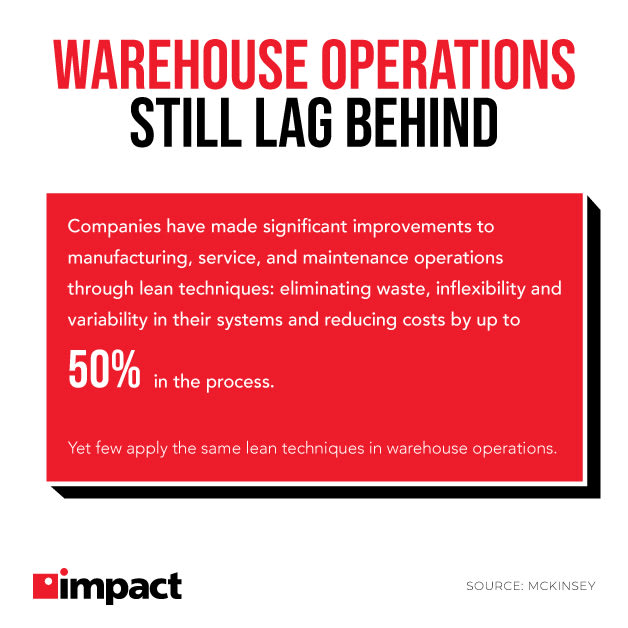
Warehouse operators are no longer asking whether lean processes are worth the effort. They're finding out how much productivity they've been leaving on the floor without them.
Over the past several years, warehouses have leaned harder into digital tools, from warehouse management systems to AI-driven forecasting and robotics. But automation built on top of disorganized, inconsistent processes tends to just automate the disorganization — the inefficiencies were never really about the technology.
Order picking can account for more than 55% of total warehouse operating costs, and over half of that time is typically spent walking the floor rather than picking.
The result is a widening gap between operations that have built a genuinely lean foundation and those layering new technology onto old habits.
Lean warehousing addresses this directly. It's the same methodology behind lean manufacturing, applied to how a warehouse is organized, staffed, and run day to day—and it's what determines whether automation investments actually pay off or just move the bottleneck somewhere else.
The 5S system is the most widely used framework for getting there.
What Is Lean Warehousing?
Lean warehousing is a process for achieving the most efficient level of operations in a warehouse by eliminating seven possible kinds of waste without impacting productivity.
The concept of “lean” was developed by Japanese auto manufacturer Toyota in the 1930s as a way of streamlining their manufacturing processes. It has since been adopted as a model for operations worldwide.
The 7 “wastes” outlined are as follows:
- Inventory: Excessive, overstocked products
- Waiting: Labor costs from a lack of productivity
- Defects: Products that need re-working or scrapping
- Overproduction: Producing more than the market demands
- Motion: Unnecessary movement of employees or equipment
- Transportation: Movement of materials and product
- Over-processing: Doing additional work that brings no value
While originally intended for manufacturing, eliminating these wastes has been applied to warehouse management for decades to streamline operations of every size, from single-site distribution centers to multi-facility networks.
Breaking Down Lean Principles in Warehousing
Why Do I Need Lean Warehouse Management?
The short answer is that it saves money and improves productivity.
Warehouse managers have to deal with these wastes every day, so using the lean method to eliminate them and keep your working processes tight is crucial to ensure you’re getting the most out of what you’ve got.
Now, typically when we’re talking about improving operations, we’d look at how digital solutions can improve functions, like an ERP for example.
What’s notable about warehouse operations, however, is that many of the obstacles are completely non-digital. In other words, an organization’s operations can grow increasingly unproductive simply through a buildup of minor processes that aren’t up to standard.
This is where a lean mindset can make great strides; by adopting a number of changes that will change the approach to how the warehouse is organized, and then maintaining those changes for the future.
Why Lean Warehouse Management Matters Now
Warehouse operators are also contending with a persistent labor shortage, the large majority of supply chain and logistics operations report notable workforce shortages, with warehouses among the hardest hit. That makes every hour of labor more expensive to waste, and it's exactly the kind of waste lean processes are built to eliminate.
What's notable about warehouse operations is that many of the biggest obstacles are completely non-digital. An organization's output can decline steadily simply through a buildup of minor processes that fall below standard, long before any technology gets involved.
A lean mindset addresses that directly by adopting changes to how the warehouse is organized and run, then maintaining those changes going forward.
Core Principles for Lean Warehousing
This quick lean warehouse management methodology is implemented by businesses to better their efficiency, improve their organizational methods, and standardize their processes.
There are five aspects of the 5S system: Sort, Set in Order, Shine, Standardize, and Sustain.
Related: Intelligent Process Optimization for Manufacturing, Distribution, and Logistics
Sort Your Lean Warehouse Ideas
The first step is to sort your warehouse—identifying what you need and what you don’t.
What to do:
Eliminate clutter and clear spaces that have unnecessary items in them. Pay close attention to what equipment and materials are in any given area, and ask yourself whether it’s necessary for them to be there.
Some items might need to be put into another area where they’re better suited, and some removed entirely.
If you can’t identify an item or where it needs to go, tag it so that others might be able to.
If it goes unclaimed, sell it, recycle it, or throw it away, unless you’re sure that your operations definitely need it, in which case, store it for later use.
Set Ideas in Order
Set in Order effectively translates as streamlining your physical setup—in other words, allowing for the most efficient use of movement around the building.
What to do:
The goal of this step is to organize your warehouse. Build a floor map to determine where materials and equipment should be kept and design a foot and machinery traffic flow to improve efficiency.
Put frequently used items and equipment in easy-to-access areas, and instructions to reduce retrieval time for employees.
This communication with workers through labeling and signs is vital to getting everything running smoothly—the last thing you want to do is re-arrange your entire warehouse floor and not let the workers know where anything is.
This also makes it easier for new employees to understand how to perform their jobs in the warehouse.
In a fulfillment warehouse, walking is “the enemy of efficient order picking. In fact, it can comprise as much as 50% of the picking process – and up to half of your warehousing labor cost. Without the right system-aided picking process, you’re paying order pickers to walk, not to pick.”
Keep Your Lean Warehouse Organized
It’s important to make sure your warehouse is organized and clean to establish effective lean warehouse principles. This basically comes down to making sure you keep your warehouse tidy, but it’s a lot more than just getting a mop and bucket out or organizing shelving.
What to do:
The key advantage to keeping your warehouse clean is that it gives you an opportunity to effectively perform preventative maintenance, this is especially the case if workers take ownership of their own areas.
They will be able to identify missing items, misplaced items, and issues with machinery that would otherwise go unnoticed; helping you recognize a small problem before it causes a much bigger issue.
Standardize Lean Warehouse Practices
Standards in the workplace are important; standards in a warehouse are even more important when you’re trying to maximize productivity.
62% of respondents reported human error from manual process management as the #1 root cause of inventory fulfillment issues.
What to do:
All processes should be standardized, and employees should have a very clear understanding of what they are expected to do and have the materials available to them that allows the completion of tasks.
These are usually done through checklists and best practices and procedures made visible and accessible to staff. By doing so, you also introduce proper accountability so that the staff knows what is expected of them and understands the means to do so.
No one is left wondering what they’re supposed to do or left guessing how to perform their job.
These standards should be easy to understand and easy to access, whether it’s a poster or an online document. For new employees, use training manuals to get them up to speed as quickly as possible.
Once you’ve established a set of standardized procedures, you may even adopt automation solutions, as many other businesses have already done.
Introduce Sustainable Lean Solutions
When we talk about improving business processes with our customers, a large emphasis is placed on continuous development—it’s never a case of one-and-done solutions.
In the original Japanese methodology, it directly translates as “discipline”, meaning that once you’ve established your new rules and practices, you must maintain your discipline in upholding them and continually improving them.
More than 3 in 10 warehouses and distribution centers are currently using or considering robotics.
What to do:
In essence, it means that every principle—from steps one to five—of lean warehouse operations should be applied consistently.
For example, if over time the floor plan for movement efficiency isn’t working as intended, then revisit it. If there’s a buildup of equipment in an area, apply the first step again.
To achieve this, ensure that managers are committed to the five steps; without their direction, you may struggle to uphold the practices—and your improved efficiency.
The 5S System
Lean warehouse management is typically implemented through the 5S system: Sort, Set in Order, Shine, Standardize, and Sustain. Each step builds on the one before it, and skipping ahead tends to undo the ones you've already done.
Sort
Start by identifying what your warehouse actually needs and what it doesn't. Walk each area and catalog every item, identifying whether or not it truly belongs there, or if it should be inventoried/stored somewhere else.
Items that don't have an obvious home get tagged so someone else can weigh in, rather than left to accumulate. From there, unclaimed items get sold, recycled, or discarded — unless the operation genuinely needs them, in which case they're stored properly rather than left in the way.
This step alone tends to do a lot of the heavy lifting. Clearing expired stock, broken pallets, and excess packaging frees up space, reduces the odds of inventory errors, and gives the rest of the 5S process a clean starting point to build from.
Set in Order
Once the clutter is gone, the question becomes how people and materials actually move through the space. A floor map showing where equipment and materials should live, paired with a defined traffic flow for foot and machinery movement, turns a warehouse from a maze into a system.
Frequently used items belong in easy-to-reach spots, ideally near dispatch, with signage that tells people where things are without requiring a phone call to a supervisor. That last part matters more than it sounds; a rearranged floor that nobody's been told about just replaces one kind of inefficiency with another.
The stakes here are higher than they might seem. Industry research consistently finds that travel time accounts for roughly half of the total picking process in a typical warehouse — meaning a significant share of labor spend goes toward walking, not picking, whenever layout and flow aren't optimized.
Shine
Shine is often mistaken for a cleaning step, and it is one, but the value runs deeper than tidiness. A clean, well-maintained space doubles as an ongoing inspection: workers who take ownership of their area are far more likely to spot a missing tool, a misplaced pallet, or a piece of equipment that's starting to fail before it becomes a bigger problem.
There's also a safety dimension that's easy to overlook. Slips, trips, and falls remain one of the leading causes of non-fatal warehouse injuries, and the transportation and warehousing sector logs injury rates well above the national average across industries. Cluttered aisles, spills, and poor housekeeping are recurring contributors. Routine sweeps — done as a scheduled discipline rather than an occasional catch-up — cut down on both.
Standardize
Standards are what keep Sort, Set in Order, and Shine from quietly unraveling. Without a documented, visible process, individual habits start to drift, and manual, inconsistent workflows remain one of the most common root causes of inventory and fulfillment errors across the industry.
The fix isn't complicated: checklists, best practices, and procedures that are actually accessible to staff, not buried in a binder somewhere. New hires get up to speed faster when there's a training manual to hand them instead of relying on tribal knowledge.
And once a standard exists, it becomes something you can actually audit against, which is what makes the next step possible.
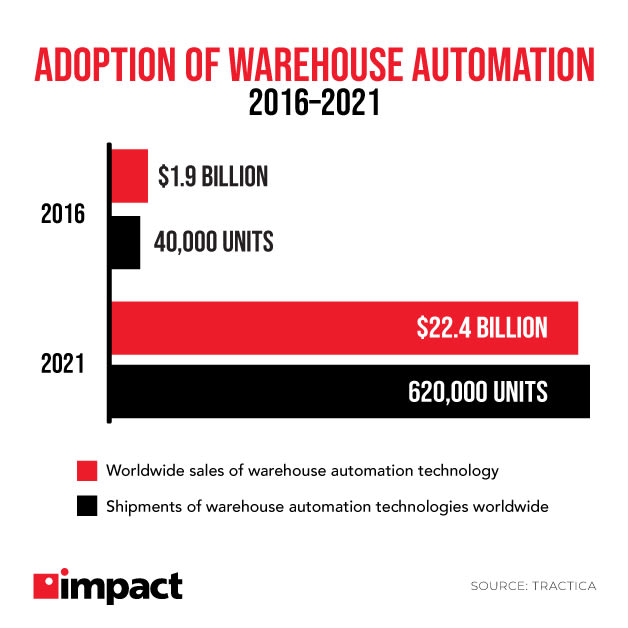
This is also the stage where many operations start layering in automation. The global warehouse automation market is now valued in the tens of billions of dollars and continues to grow at a double-digit rate annually, driven largely by labor shortages and rising e-commerce demand.
Even so, most warehouses worldwide have yet to automate at all, which means standardized, lean processes remain the single biggest lever most operations have available today, automation or not.
Sustain
Sustain is where most lean initiatives quietly fail — not because the first four steps didn't work, but because nobody kept doing them once the initial push wore off. In the original Japanese methodology, this step translates roughly as "discipline": once new rules are in place, maintaining them takes as much intention as building them did.
That means treating the 5S process as a loop, not a project with an end date. If a floor plan stops working as traffic patterns shift, revisit Set in Order. If equipment starts piling up in a corner again, revisit Sort.
Manager buy-in tends to be the deciding factor here; without leadership consistently reinforcing the standard, teams drift back to whatever's easiest in the moment, and the efficiency gains go with them.
Key Takeaways
- "Lean" is a proven methodology that originated in manufacturing but applies just as well to warehouse operations of any size.
- The 5S system — Sort, Set in Order, Shine, Standardize, and Sustain — gives lean warehousing a structure that's simple to start and hard to skip steps in.
- The biggest risk isn't failing to implement lean practices; it's failing to sustain them once the novelty wears off.
Wrapping Up on Lean Warehouse Operations
Lean warehousing isn't a one-time project; it's a discipline that has to hold up after the initial cleanup, the new floor plan, and the first round of training manuals stop feeling new. The warehouses that get the most out of 5S treat it as an ongoing standard to maintain, not a box to check.
That foundation is also what determines whether the next investment actually pays off. A warehouse that's sorted, organized, and standardized is in a position to layer in automation, AI-driven forecasting, or a new WMS and see a real return. One that hasn't done the work first just ends up automating the same inefficiencies, faster.
For more information about how tech solutions can help your SMB, download our free eBook, Fast-Tracking Your Digital Transformation, featuring an entire chapter on Enterprise Resource Management, which helps improve the efficiency of your supply chain and other warehouse processes.