There are a lot of moving parts in a fully-fledged marketing strategy that all need to work together to successfully build a brand from voice, to core messaging, and, of course, brand awareness. Imagine the number of manuscripts that went unpublished and faded away into history, never seeing the light of day. There’s a chance some of the best writing in the world is simply unpublished and unseen.
This is the role that paid media plays in the marketing world; it gives brands the ability to expand the pure reach of the content of which they’re most proud. This means getting more traffic on your staple pieces, thought leadership papers, and experimental content that you publish.
As such, paid media in marketing is critical to getting the right message, or right piece of content, in front of the right person, at the right time, in the right space. Phew – that's a lot of things that have to go right.
Join us below to learn more about the function of paid media, how it works with other aspects of marketing, and why it’s a pillar in comprehensive marketing strategies.
To get specific ideas on how you can improve your current marketing strategies with real insights, watch Impact’s webinar, Assessing Your Marketing: An Inside Look.
What Is Paid Media?
Paid media refers to any marketing effort where a brand pays to amplify its message, ensuring visibility beyond organic reach. This includes digital ads, sponsored content, and influencer partnerships, strategically placed to target specific audiences.
Unlike earned or owned media, paid media offers immediate exposure and precise audience targeting but requires continuous investment to sustain momentum. When executed well, it blends seamlessly into a consumer’s digital experience, driving engagement while maintaining brand credibility.
For example, paid media marketing can:
- Make your website a sponsored link on Google
- Make your ads and posts get more impressions on social media
- Get an influencer to promote your product or brand
- Use re-targeting ads to engage with users who have interacted with your website or app
- Take advantage of traditional media such as billboards or TV ads
As you can see, paid media, which also includes PPC (pay-per-click) ads, promotes content externally and is typically served to a specific audience based on demographic targeting.
The goal for paid media campaigns is to attract audiences to a piece of content, web page, or action, which starts them down your content funnel or customer journey.
What Is a Paid Media Strategy?
A paid media strategy defines how a brand uses paid channels to achieve specific business goals. Where planning focuses on budgets, timing, and allocation, strategy sets the direction. It clarifies what success looks like, which audiences matter most, and how paid media supports broader marketing and revenue objectives.
At a high level, a paid media strategy answers three core questions: who you’re trying to reach, what action you want them to take, and which channels are best positioned to influence that behavior. That might mean prioritizing upper-funnel reach through social and video, capturing high-intent demand through search, or using retargeting to accelerate consideration and conversion.
A strong paid media strategy typically includes:
- Clear objectives tied to business outcomes, such as pipeline growth, customer acquisition, or retention
- Audience definition based on first-party data, behavioral signals, and platform capabilities
- Channel roles that specify how each platform contributes across the funnel
- Measurement and KPIs that move beyond clicks to track impact on revenue or meaningful conversions
Most importantly, a paid media strategy provides focus. It helps teams avoid spreading budget too thin, aligns creative and messaging with intent, and creates a consistent framework for optimization over time. Without a strategy, paid media becomes reactive. With one, it becomes a lever for intentional, repeatable growth.
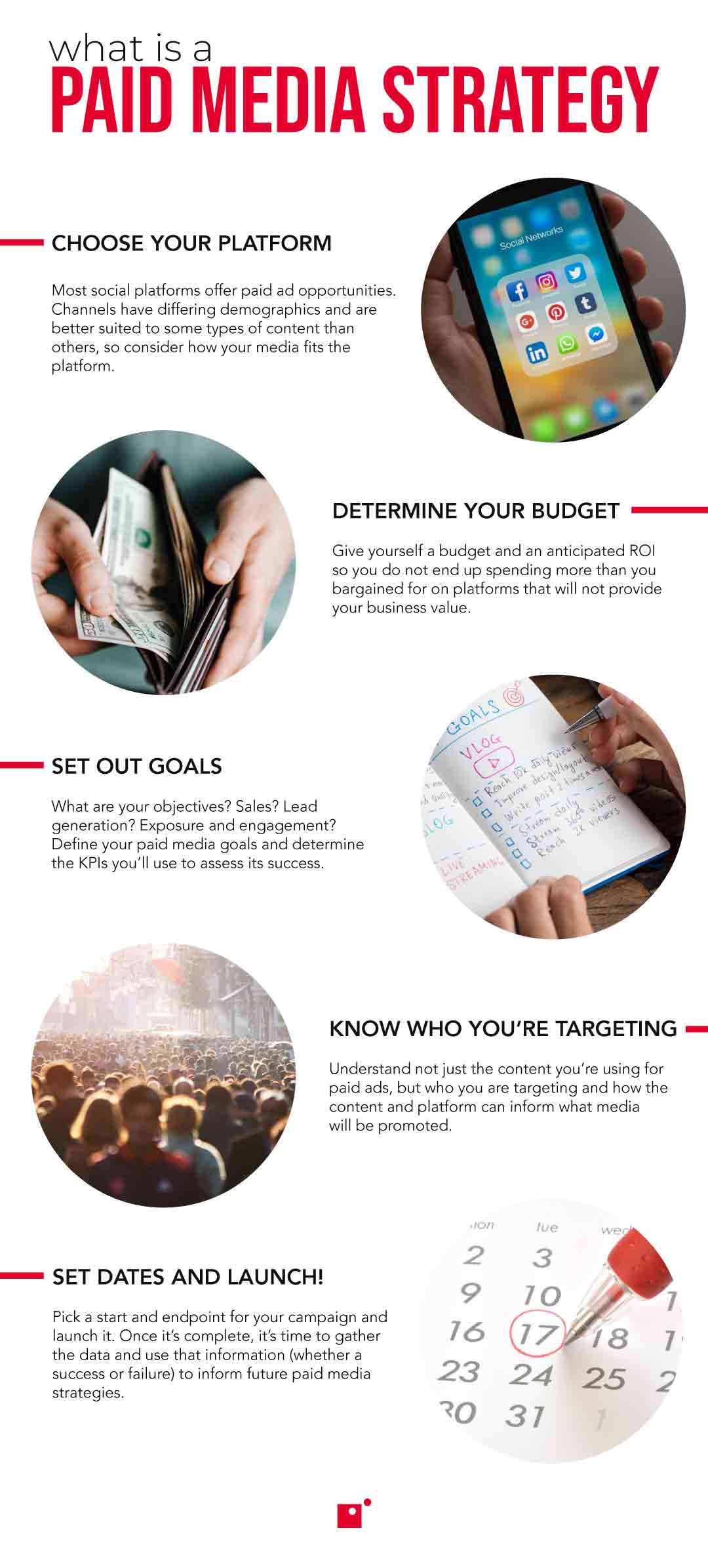
The infographic below further explains what a paid media strategy is and how the core components work together to attract an interested audience.
Paid Media Planning
Paid media planning is where strategy meets restraint. It’s not about buying more impressions, it’s about deciding which channels, audiences, and moments are worth paying for, and why. A strong plan aligns business goals with media mix decisions so spend ladders directly to outcomes, not vanity metrics.
At its core, paid media planning starts with clarity. That means defining the role paid channels play across the funnel, whether awareness, demand capture, or acceleration, and setting guardrails around budget, timelines, and performance benchmarks. From there, planners can map spend to platforms based on audience behavior, creative fit, and historical efficiency rather than defaulting to last year’s allocation.
Effective plans also build in flexibility. Market conditions shift, algorithms change, and creative fatigue is real. The best paid media plans account for this by:
- Reserving budget for testing new formats, audiences, or platforms
- Setting clear optimization triggers tied to business KPIs
- Balancing always-on campaigns with timely, high-impact flights
When done well, paid media planning creates focus. It gives teams a shared framework for decision-making, reduces reactive spending, and turns paid media from a cost center into a repeatable growth lever.
Difference Between Paid, Earned, and Owned Media
Paid media, as we noted, refers to content that is externally placed for a fee. This differs from the other types of outbound marketing like earned and owned media, which we explore further below.
Earned media refers to content that is about your business or something related to your business that you haven’t paid for. In other words, this kind of content often exists as articles or interviews about an organization created with no financial incentive.
Examples of earned media include:
- Reposts by others of your online content
- Positive reviews
- Word-of-mouth marketing
Owned media refers to content that is created and owned by your organization, and featured in your proprietary channels.
Examples of earned media include:
- Blogs
- Podcasts
- Videos
- Social Media Content
- Apps
- Email newsletters
A Word on the Relationship Between Content and Paid Media
Content and paid media go hand-in-hand with one another. Content is the heart of your message—it’s the engaging video, insightful blog post, or vibrant social media image that tells your brand's story. However, even the most captivating content can go unnoticed without the strategic boost that paid media provides.
Paid media, through targeted ads and sponsored placements, ensures that your content reaches the right audience at the right time, amplifying your message beyond organic reach.
This relationship means that content fuels engagement while paid media drives visibility. By investing in paid channels, you can target specific demographics and interests, creating a funnel that brings interested consumers directly to your compelling content.
Together, paid media and content not only enhance brand awareness but also drive measurable results, turning creative storytelling into a powerful engine for business growth.
A Comprehensive Marketing Strategy Includes Paid, Earned, and Owned Media
A comprehensive marketing strategy thrives on balance, and that’s where the trifecta of paid, earned, and owned media comes into play.
Paid media—such as ads and sponsorships—delivers immediate reach, ensuring your message gets in front of the right audience at the right time. But relying solely on paid efforts can be costly and unsustainable. That’s where owned media, like a brand’s website, blog, or email list, provides a stable foundation—giving businesses control over their messaging and a direct line to their audience.
Earned media, like social shares and customer reviews, build brand credibility and authority. Unlike paid efforts, earned media is not directly controllable, but when combined with paid and owned tactics, it amplifies brand awareness organically.
Together, these three elements create a marketing strategy that is both resilient and dynamic—maximizing visibility, fostering trust, and driving long-term growth.
Taking and Analyzing Metrics
Performance data is the difference between running campaigns and actively managing them. Taking and analyzing metrics should be an ongoing discipline, not a check-in reserved for month-end reports. The goal is to understand what the data is telling you about audience behavior, platform efficiency, and creative effectiveness so you can make informed adjustments in real time.
Start by focusing on metrics that align directly with your campaign objectives.
Click-through rate, conversion rate, cost per acquisition, return on ad spend, and impression share all tell different parts of the story, but not every metric matters equally for every campaign. A lead generation campaign, for example, should prioritize qualified conversions and CPL over surface-level engagement metrics like likes or impressions.
Tracking everything without context often leads to noise rather than insight.
Analyzing metrics also requires looking beyond platform dashboards in isolation. Performance trends over time, comparisons between audiences, and differences across creative variations are where optimization opportunities usually surface.
If one audience segment consistently converts at a lower cost or one creative format drives higher-quality traffic, that data should inform how budgets are shifted and campaigns are structured moving forward.
Finally, metrics should be used to guide decisions, not just justify past performance. Regular analysis allows paid media teams to identify underperforming spend, test smarter hypotheses, and continuously refine targeting, messaging, and bidding strategies.
A strong paid media plan doesn’t just report results; it uses metrics as an active feedback loop to improve efficiency and scale what’s working.
Wrapping Up on the Value of Paid Media Marketing
A paid media strategy is important for businesses because it’s a promotional avenue that offers the chance for businesses to create exposure for their content and increase their brand awareness in a short period of time.
Unlike owned and earned media, which often rely on organic means to drive visitors to content, paid media is a far more direct method of outreach that can target very specific topics—often relating to an individual service or product.
For this reason, it’s important for marketing teams to have a PPC strategy for their content to get it in front of the right audiences at the right time.
Get inspired and find actionable insights that drive real marketing results in Impact’s webinar, Assessing Your Marketing: An Inside Look.